
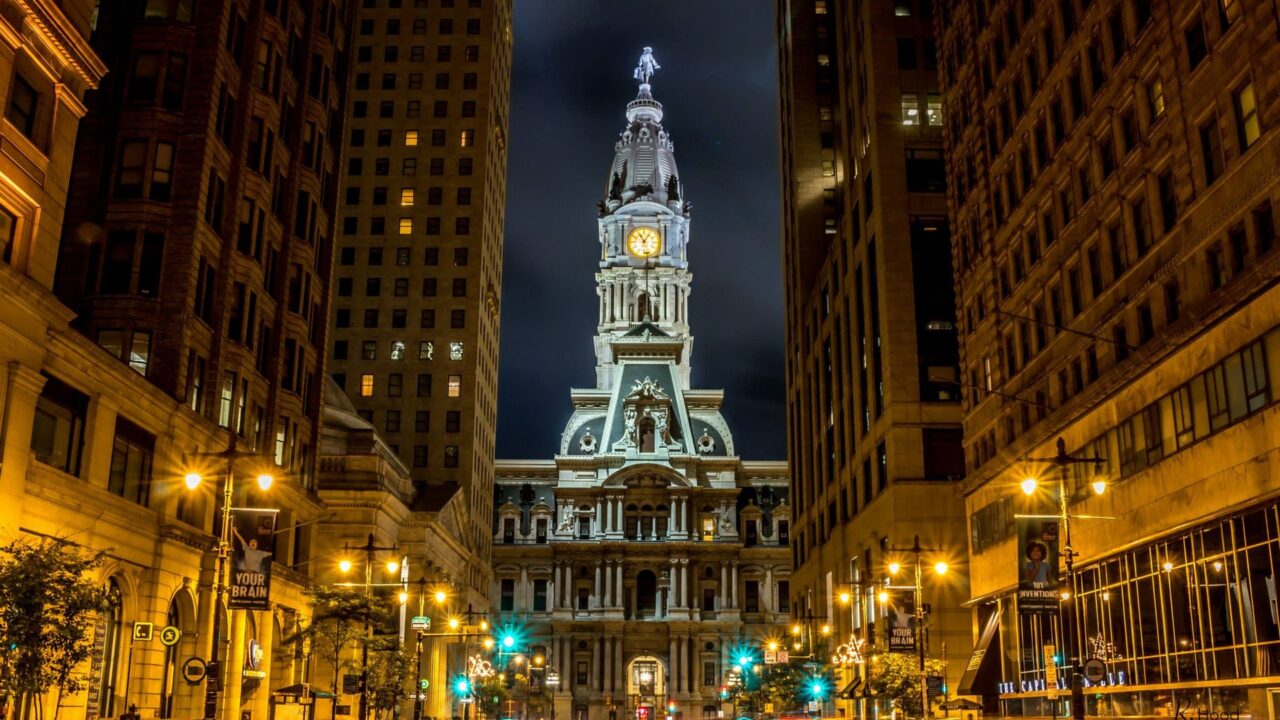
Philadelphia City Hall Travel Guide (2026)
Philadelphia City Hall is both the working center of city government and one of America’s most ambitious municipal buildings. Its immense Second Empire exterior, sculpture-covered portals, central courtyard, William Penn tower, and open-air observation deck turn a civic landmark into an architecture, public-art, and skyline experience.
Experience Profile
PRIMARY EXPERIENCE
SECONDARY EXPERIENCES
Why It Is Worth Visiting
City Hall occupies four and a half acres at the center of Philadelphia and rises more than 547 feet to the top of Alexander Milne Calder’s William Penn statue. The masonry-bearing structure is a remarkable late-19th-century engineering achievement, while more than 250 exterior and interior sculptures make the building an enormous civic artwork.
DananaGo’s verdict: Philadelphia City Hall deserves map-level status because no other stop combines monumental architecture, civic history, public art, and a high central viewpoint so efficiently. The exterior and courtyard can reward a short visit, while a building or tower tour turns it into a substantial experience. Allow 45–90 minutes, or longer when taking both tours.
What to Experience
The Second Empire Exterior
Walk around all four sides rather than treating City Hall as a single façade. Towers, mansard roofs, arched portals, dormers, columns, carved stone, and sculptural groups create a constantly changing composition. Broad Street gives the strongest full-height view, but close inspection at the portals reveals the building’s craftsmanship.
Calder’s Sculptural Program
Look for the different themes assigned to the north, east, south, and west central pavilions. Allegorical figures, animals, historical references, continents, trades, virtues, and government symbols form a visual language tied to the functions once located behind each entrance. The William Penn statue remains the culminating landmark.
Courtyard and Civic Interiors
Pass through a portal into the central courtyard to understand the building’s scale and circulation. When available, the official building tour adds selected ceremonial and governmental interiors, historical context, and details that are easy to miss from the street. Access depends on city operations and scheduled tours.
Tower Tour and Observation Deck
A small elevator climbs to the open-air deck beneath William Penn, about 548 feet above ground. The compact viewpoint gives unusually direct views along the Benjamin Franklin Parkway, Broad Street, and the Center City skyline. Capacity is limited, advance booking is wise, and weather can change the schedule.
Plan Your Visit
| Address | 1400 John F. Kennedy Boulevard, Philadelphia, PA 19107 |
|---|---|
| Recommended time | 45–90 minutes; allow additional time if combining building and tower tours |
| Tour hours | Tower tours are generally offered Monday–Friday, 10:00 a.m.–2:45 p.m.; building tours are scheduled separately |
| Admission | Exterior and courtyard viewing are free; official tours require tickets |
| Best time | Weekday morning for tours; blue hour or evening for exterior photography |
| Getting there | SEPTA City Hall Station, 15th Street Station, multiple bus routes, bike share, or Center City walking routes |
| Accessibility | Building access varies by route and civic operations; the small tower elevator and observation deck are not wheelchair accessible |
Before visiting, confirm current tower-tour hours, tickets, weather notices, and access information. The Visitor Center is in Room 121 at the east portal. For the sculpture program, consult the Association for Public Art’s City Hall guide.
A Smart 75-Minute Route
- Begin on South Broad Street for the most legible full-height view of the tower and façade.
- Circle the building clockwise, comparing the themes and sculpture of the four central portals.
- Enter the courtyard and look back through the arches to understand the building’s plan.
- Join the building tour if available, concentrating on spaces that cannot be seen independently.
- Take the reserved tower slot and identify the Parkway, Broad Street, and surrounding Center City landmarks.
- Finish with the public artworks around Dilworth Park and LOVE Park.
DananaGo Tips
- Reserve the tower first: its tiny elevator and limited capacity make it the least flexible part of the visit.
- Check the weather: wind, visibility, and severe conditions can close or diminish the observation-deck experience.
- Walk all four sides: each portal carries different sculptural and governmental themes.
- Bring a zoom lens: many of Calder’s figures and details sit far above street level.
- Combine nearby stops: Reading Terminal Market, LOVE Park, the Parkway, and the Masonic Temple fit naturally before or after City Hall.
Experience It Online
The Association for Public Art’s Around City Hall tour turns the building and surrounding plazas into a cloud-travel route. Its interactive map and individual artwork pages connect William Penn, the City Hall sculptural program, the Octavius V. Catto Memorial, LOVE, Clothespin, and other nearby works with concise historical and artistic context.
Explore More of Philadelphia
Use the map below to discover more must-see attractions across Philadelphia and compare their locations with your current position.