
Reading Terminal Market Travel Guide (2026)
Reading Terminal Market is Philadelphia’s most complete food experience under one roof: a historic public market where Pennsylvania Dutch traditions, local specialties, fresh produce, bakeries, counters, and cuisines from across the city meet in a lively shared space. It is both an excellent meal stop and one of the clearest windows into everyday Philadelphia.
Experience Profile
PRIMARY EXPERIENCE
SECONDARY EXPERIENCES
Why It Is Worth Visiting
Operating in its landmark building since 1893, the market remains a working urban food hall rather than a preserved exhibit. More than 75 small, family-owned businesses create a rare mix of prepared meals, groceries, regional products, and specialist merchants. The range makes it useful for mixed groups: everyone can choose independently and meet at the central seating areas.
DananaGo’s verdict: this is a map-level attraction and Philadelphia’s strongest single stop for food variety and local atmosphere. Budget 90 minutes for a focused meal and walk-through, or two to three hours if you want to compare stalls and shop.
What to Experience
Philadelphia Classics
Use the market to compare recognizable city flavors without building an itinerary around isolated restaurants. Roast pork, cheesesteaks, soft pretzels, hoagies, cookies, ice cream, and regional baked goods are all represented, but no single order defines the market. Choose by what looks freshly prepared and by the line’s pace rather than by fame alone.
Pennsylvania Dutch Merchants
The Pennsylvania Dutch section connects the market to nearby farming communities through meats, baked goods, dairy products, produce, and prepared foods. These merchants are closed on Sundays, so visit on another day if this regional tradition is a priority.
A Global Philadelphia Food Hall
The market’s value extends well beyond legacy specialties. Caribbean, Asian, Middle Eastern, Latin American, and other cuisines reflect the city’s communities and make the experience more representative of present-day Philadelphia. A strong visit combines one local classic with something less expected.
Fresh Food, Specialty Shops, and the Building
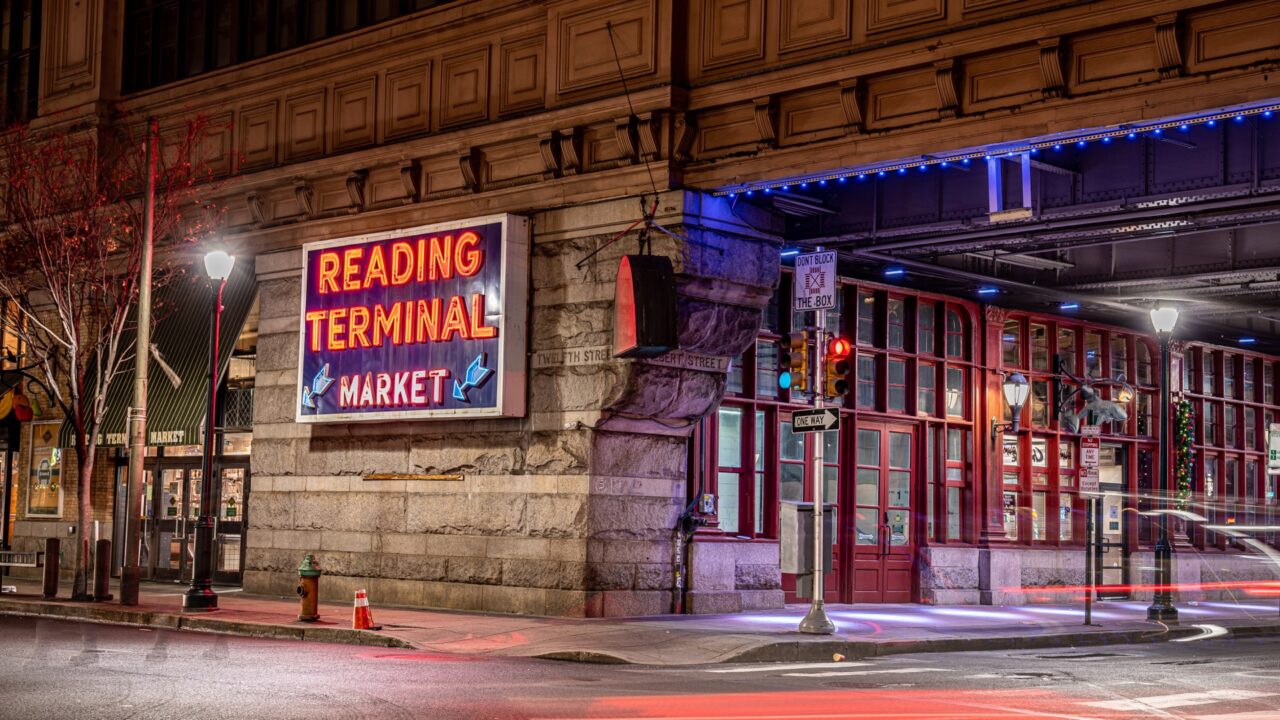
Look beyond prepared-food counters. Produce, seafood, meat, cheese, flowers, cookware, confections, and gifts preserve the market’s original role as a place to shop. Overhead signs, narrow aisles, the train-shed history, and the neon exterior give the building a visual identity that rewards a complete loop.
Plan Your Visit
| Address | 1136 Arch Street, Philadelphia, PA 19107 |
|---|---|
| Recommended time | 1.5–2 hours for a meal and full walk-through; longer for shopping |
| Regular hours | Daily, 8:00 a.m.–6:00 p.m.; individual merchant hours vary |
| Admission | Free to enter; food and purchases are pay as you go |
| Best time | Weekdays before 11:00 a.m. or after 2:00 p.m. for lighter crowds |
| Getting there | Direct access from Jefferson Station; close to SEPTA subway, bus, trolley, PATCO, walking, and bike routes |
| Parking | Partner garages near 11th and Arch and 12th and Filbert offer time-limited validated rates; confirm current terms |
| Accessibility | The market is on one level; most entrances are step-free, with automatic openers at Doors 6 and 9, accessible restrooms, parking, and indoor seating |
Before visiting, check the official hours and holiday schedule, merchant directory, directions and parking, visitor FAQ, and facility accessibility information. Individual stalls, menus, prices, and holiday hours change.
A Smart Ninety-Minute Route
- Enter without ordering immediately and complete one short orientation loop.
- Identify one Philadelphia or Pennsylvania Dutch specialty and one contrasting cuisine or snack.
- Order the slower or most popular item first, then use the waiting time to choose a drink or dessert.
- Eat in a shared seating area rather than blocking a merchant aisle.
- Walk the outer and grocery-focused aisles after the meal, when you can browse without rushing.
- Finish at the neon sign or historic exterior for the building’s sense of place.
DananaGo Tips
- Do not arrive with one mandatory stall: lines, sellouts, and merchant hours vary; build a flexible shortlist.
- Avoid the noon crush: convention traffic and weekday lunch crowds can make navigation and seating difficult.
- Split portions: sharing two or three smaller orders gives you a better market experience than one oversized meal.
- Bring payment options: merchants generally accept cash and major cards, while digital-payment policies vary.
- Plan Sundays carefully: Pennsylvania Dutch merchants are closed even though the overall market remains open.
Experience It Online
The official merchant directory is the most useful remote experience available: explore the current mix of bakeries, eateries, produce stands, specialty shops, and Pennsylvania Dutch merchants, then build a personal tasting route before arrival.
Explore More of Philadelphia
Use the map below to discover more must-see attractions across Philadelphia and compare their locations with your current position.