
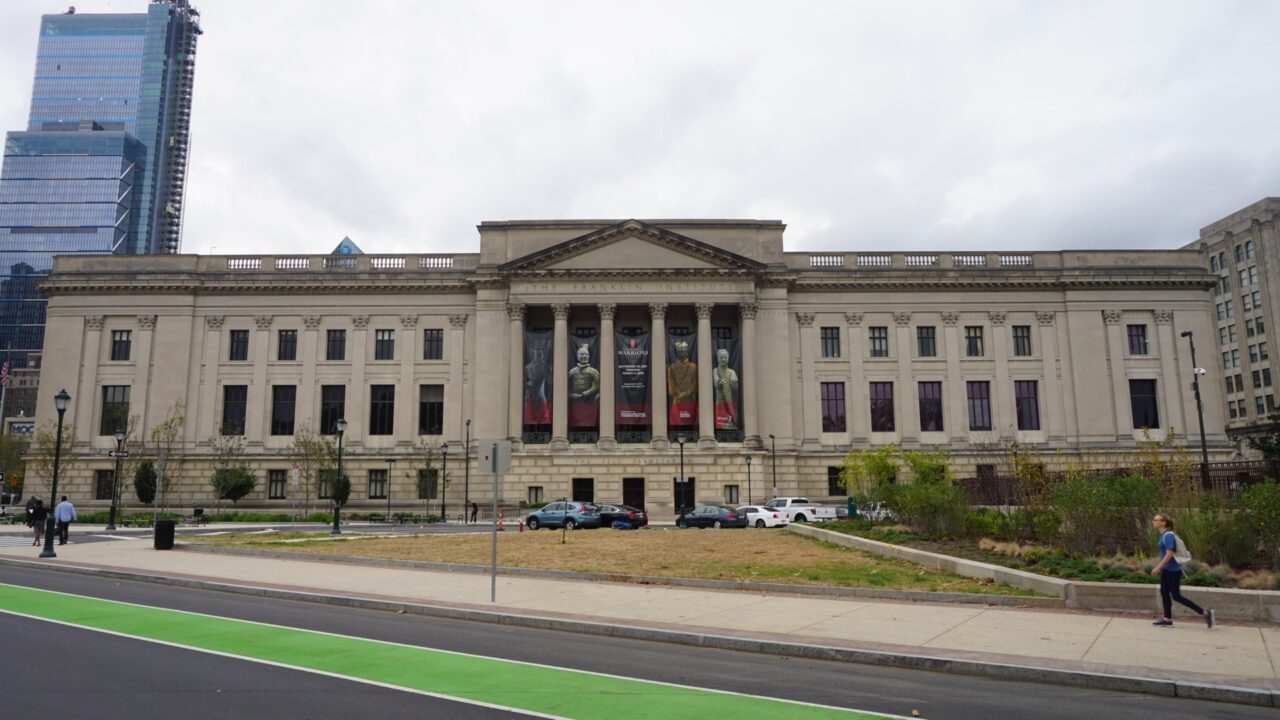
The Franklin Institute Travel Guide (2026)
The Franklin Institute is Philadelphia’s landmark hands-on science museum: three floors of experiments, historic machines, live demonstrations, a planetarium, and immersive exhibits that turn the human body, the brain, space, electricity, engineering, and motion into experiences visitors can test for themselves.
Experience Profile
PRIMARY EXPERIENCE
SECONDARY EXPERIENCES
Why It Is Worth Visiting
Founded in 1824, the Institute combines the legacy of Benjamin Franklin with a modern science-center approach built around touching, testing, climbing, observing, and asking questions. Its strongest experiences are not passive displays: visitors walk through a giant heart, fire a model neuron, experiment with physical forces, encounter historic engineering artifacts, and watch science demonstrations unfold in real time.
DananaGo’s verdict: this is a map-level Philadelphia attraction because it delivers a full half-day of participatory science for families, curious adults, and school-age travelers. It is most rewarding when visitors choose a few themes and explore them deeply instead of racing through every floor.
What to Experience
Body Odyssey and the Giant Heart
The Giant Heart has been a Philadelphia rite of passage since 1954. Now placed within Body Odyssey, it anchors a broader exploration of biological systems, health, medical technology, and the ways body systems work together. Walk the route of a blood cell, then spend time with the surrounding simulations instead of treating the Heart as a photo stop.
Your Brain
Fire a model neuron, test how the brain combines sensory information, explore visual and audio illusions, and—if appropriate for your group—climb the 18-foot neural network. This gallery is one of the museum’s best examples of turning complex biology into physical, memorable actions.
Historic Machines and Engineering
The Baldwin 60000 steam locomotive, aviation artifacts, and engineering collections connect hands-on science to Philadelphia’s industrial history. Look for the design decisions behind each machine: how force is transferred, how materials solve structural problems, and how inventors balanced power, control, and safety.
Fels Planetarium and Live Science
General admission includes scheduled planetarium programming and daily live science experiences, but times vary. Build the day around one planetarium show and one demonstration, then use the exhibits between them. The Benjamin Franklin National Memorial in the rotunda adds a quieter architectural and historical counterpoint.
Plan Your Visit
| Address | 222 North 20th Street, Philadelphia, PA 19103 |
|---|---|
| Recommended time | 3–4 hours; allow longer for a special exhibition or multiple scheduled shows |
| Regular hours | Daily, 9:30 a.m.–5:00 p.m.; closed on selected major holidays |
| Admission | General admission covers three floors of hands-on exhibits, live science programs, and a Fels Planetarium show; special exhibitions cost more |
| Best time | Weekday opening time or later afternoon; school groups are often concentrated in the morning |
| Getting there | Walk from Center City, SEPTA bus, Philly PHLASH, rideshare, bike share, or the paid on-site garage at 271 North 21st Street |
| Accessibility | Accessible entrances and garage route, elevators, courtesy wheelchairs, seating, sensory backpacks and guide, PCA access, and advance ASL requests |
Before visiting, confirm the official hours and visit information, ticket options and current special exhibition, and accessibility resources. Prices, show schedules, temporary closures, and special exhibitions can change.
A Smart Three-Hour Route
- Check the daily schedule on arrival and reserve your route around one planetarium show and one live demonstration.
- Begin with Body Odyssey and the Giant Heart before lines build.
- Move to Your Brain and complete several experiments before attempting the neural climb.
- Choose one engineering theme—train, flight, electricity, or motion—and investigate it in depth.
- Attend the scheduled show or demonstration instead of trying to finish every nearby gallery.
- End in the Benjamin Franklin National Memorial and review what your group found most surprising.
DananaGo Tips
- Use the schedule first: showtimes are the fixed points; exhibits can fit around them.
- Set a family meeting point: the museum is large, busy, and easy for groups to split up in.
- Prepare for stimulation: sound, flashing lights, crowds, and climbing elements vary by gallery; consult the official sensory guide if useful.
- Buy from the official site: the Institute warns that reseller tickets may be invalid or impossible to replace.
- Leave room for curiosity: children often spend much longer at one interactive than adults expect; depth is better than floor-by-floor completion.
Experience It Online
The Institute’s official Spark of Science collection brings short demonstrations and at-home experiments online, covering subjects such as crystals, air pressure, lasers, electricity, sound, and chemistry. It cannot reproduce the scale of the museum, but it preserves the central experience: seeing a phenomenon, asking how it works, and trying a guided experiment.
Explore More of Philadelphia
Use the map below to discover more must-see attractions across Philadelphia and compare their locations with your current position.