
Wuhou Shrine (武侯祠) Travel Guide (2026)
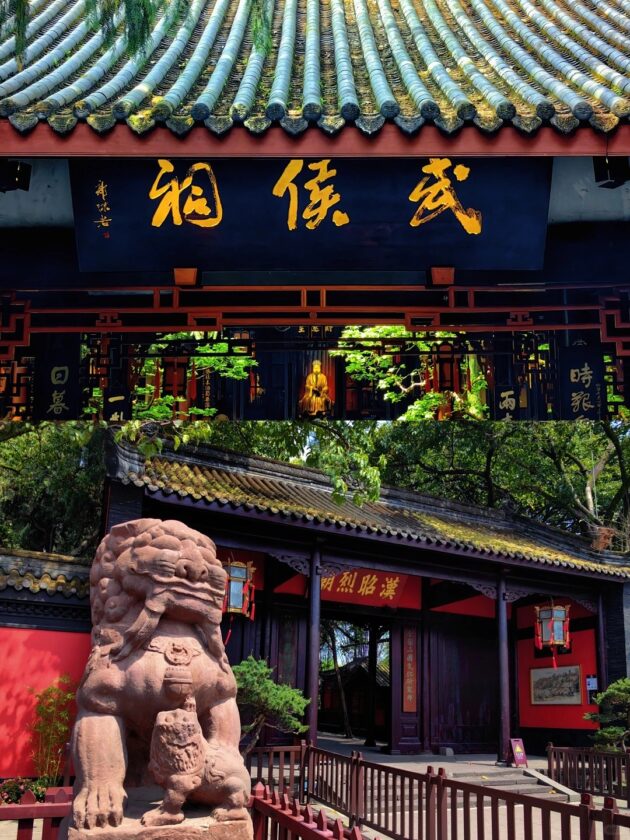
Wuhou Shrine (武侯祠) is one of China’s most famous historical sites dedicated to Zhuge Liang, the legendary prime minister and military strategist of the Shu Han kingdom during the Three Kingdoms period (220–280 AD). Revered as the “Marquis of Wu” (Wuhou), Zhuge Liang symbolises wisdom, loyalty and ingenuity in Chinese culture.
What makes this temple unique is that it also honours his lord, Liu Bei, making it the only shrine in China where an emperor and his minister are worshipped together. Surrounded by ancient cypresses, red walls and bamboo groves, Wuhou Shrine is a must-visit for history lovers, Three Kingdoms fans and anyone seeking a tranquil escape in bustling Chengdu.
Historical Background
The original temple was built in the 3rd century next to the tomb of Liu Bei (Emperor Zhaolie of Shu Han). Over the centuries, the site evolved into a combined memorial complex for both Liu Bei and Zhuge Liang. The current layout mostly dates back to the Qing Dynasty (1644–1912) and seamlessly blends temple halls, pavilions, gardens and the royal tomb. It is now a key national heritage site and also houses the Three Kingdoms Museum, which exhibits relics and artefacts from that turbulent era.
Opening Hours & Tickets (Check Real-time Prices)
Opening Hours: Summer (Apr–Oct): 08:00 – 18:30 (last entry around 18:00); Winter (Nov–Mar): 08:00 – 18:00 (last entry around 17:30)
Note: Hours may vary slightly on public holidays; it’s wise to check in advance.
Entrance Fee: General admission: 50 RMB
Half-price: Students (with valid student ID) and seniors (60–69 years old with ID)
Free: Children under 1.3m (or under 6 years old), seniors over 70 years old, and holders of relevant disability or military IDs.
Tickets can be bought on-site or via the official WeChat mini-program. An audio guide (in multiple languages) can be rented for about 20–30 RMB, or you can use QR-code scanning for free explanations on your phone.
How to Get There
Address: 231 Wuhouci Street, Wuhou District, Chengdu (成都市武侯区武侯祠大街231号)
By Metro (recommended): Take Metro Line 3 or Line 5 to Gaoshengqiao Station (高升桥站). Leave from Exit D and walk south along Wuhouci Street for about 10–15 minutes. The route is well signposted.
By Bus: Bus routes 1, 57, 82, 334, 335 and the Chengdu Sightseeing Bus all stop at Wuhouci Station. From there it’s a 2-minute walk to the main entrance.
By Taxi / Ride-hailing: A taxi from Tianfu Square or Chunxi Road area costs roughly 15–25 RMB and takes 15–20 minutes, depending on traffic. Show the driver: 武侯祠.
By Bike: Chengdu’s shared bikes (Meituan, Hellobike, Qingju) are a pleasant way to get there, especially along the shaded streets near the South River.
What to See: Top Highlights
1. The Front Gate & Tang Stele (三绝碑)
Enter through the main gate and you’ll immediately notice the serene atmosphere of ancient cypresses. Just inside stands the Tang Dynasty Stele, also known as the “Stele of Three Uniques” – celebrated for its article (written by Pei Du), calligraphy (by Liu Gongquan) and the subject matter (the achievements of Zhuge Liang). It’s the oldest and most precious relic in the shrine.
2. Liu Bei’s Hall (汉昭烈庙)
Despite the complex being called Wuhou Shrine, the main hall you first encounter is actually dedicated to Liu Bei, Emperor Zhaolie of Shu Han. A gilded statue of Liu Bei sits at the centre, flanked by his son Liu Shan and his two sworn brothers – though notably, Guan Yu and Zhang Fei have their own side halls. This layout reflects the hierarchical respect of imperial China: the emperor occupies the front hall, while the minister (Zhuge Liang) is placed behind.
3. Zhuge Liang’s Hall (诸葛亮殿)
Further back lies the heart of the entire shrine: the hall dedicated to Zhuge Liang. His statue, dressed in a Daoist robe with a feather fan in hand, captures his calm intellect. Above the hall hangs an inscription reading “名垂宇宙” (Fame Spreads Throughout the Universe). The hall is also famous for its couplets, especially the “Heart-Attacking Couplet” (攻心联) by Qing-dynasty official Zhao Fan, which reads:
“If you can win hearts, rebellion will vanish of its own accord; since ancient times those who know warfare have never delighted in war. If you fail to judge the situation, leniency and harshness alike will bring mistakes; later governors of Shu should ponder deeply.”
It’s a profound reflection on leadership and is often quoted by modern politicians.
4. Yue Fei’s Calligraphy of the “Chu Shi Biao”
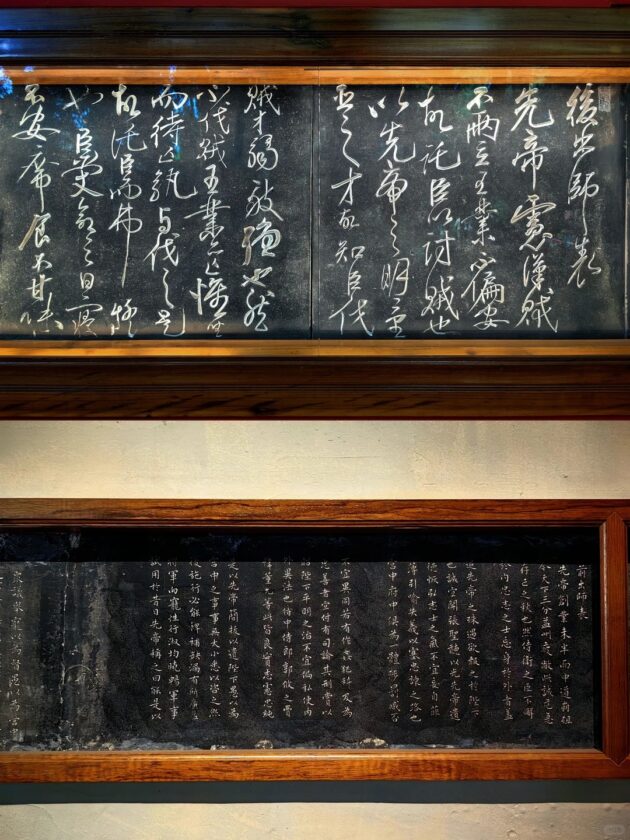
On either side of Zhuge Liang’s hall, stone tablets display the full text of Zhuge Liang’s Chu Shi Biao (出师表, “Memorial on Sending Out the Troops”) written in the passionate cursive script of the famous Song Dynasty general Yue Fei. It’s said that Yue Fei, while passing through here during a campaign, was so moved by Zhuge Liang’s loyalty that he wrote the whole memorial in one emotional sitting. The vigorous, tear-stained calligraphy is a historic treasure.
5. Red Wall Bamboo Corridor (红墙夹道)
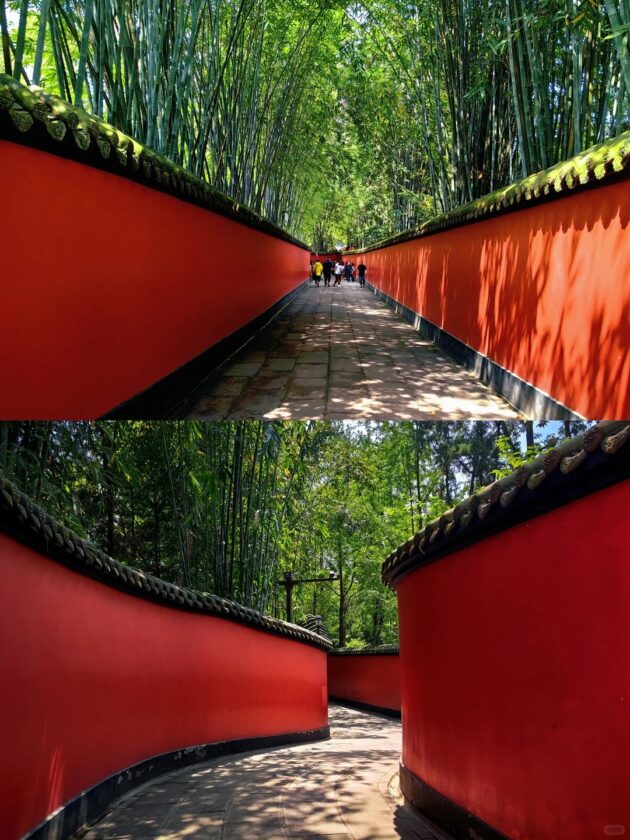
Probably the most Instagrammable spot in the shrine. This curved pathway is flanked by high, weathered red walls and lush bamboo groves, leading from Zhuge Liang’s hall towards Liu Bei’s tomb. The interplay of crimson, green and dappled light is stunning. For the best photos without crowds, visit right after opening time or late in the afternoon.
6. The Tomb of Liu Bei – Hui Ling (惠陵)
At the end of the red-wall path lies the burial mound of Liu Bei, together with his empresses Gan and Wu. It is a large, circular earthen mound enclosed by an ancient brick wall, covered in ivy and moss. A Qing-dynasty stele simply reads “汉昭烈皇帝之陵”. The quiet reverence here contrasts with the lively temple courtyards, offering a moment of true historical reflection.
7. Sanyi Temple (三义庙) & the Peach Garden
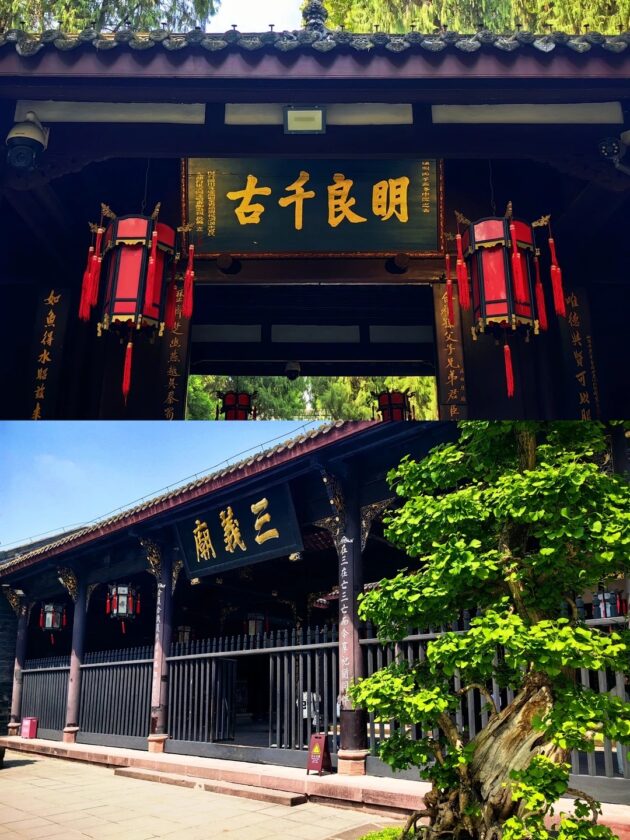
Behind the main complex stands Sanyi Temple, dedicated to the Oath of the Peach Garden – the legendary brotherhood between Liu Bei, Guan Yu and Zhang Fei. The temple was moved here from the city centre in the 1990s. Outside, an actual peach orchard evokes the original oath scene, and you’ll often see locals burning incense to honour the spirit of brotherly loyalty.
8. Three Kingdoms Museum (三国文化陈列室)
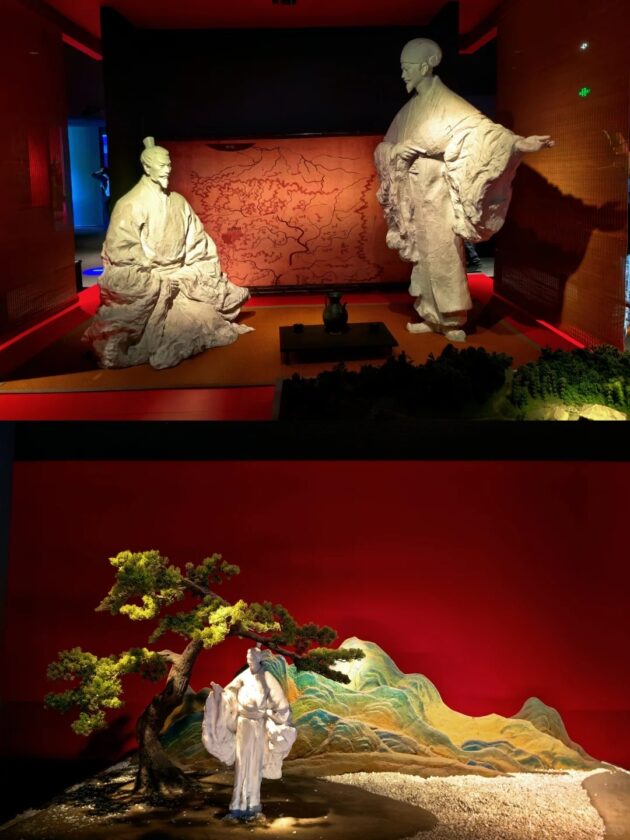
Before exiting, don’t miss the museum area on the west side of the temple. It houses pottery, weapons, coins and models from the Three Kingdoms era, along with dioramas of famous battles like Red Cliffs. The displays have English captions and provide excellent context for everything you’ve just seen.
Suggested Itinerary & Visit Tips
Recommended Route (2–2.5 hours): Main Gate → Tang Stele → Liu Bei’s Hall → Guan Yu & Zhang Fei Halls → Zhuge Liang’s Hall → Yue Fei’s Calligraphy → Red Wall Corridor → Hui Ling (Liu Bei’s Tomb) → Sanyi Temple → Three Kingdoms Museum → Exit via the side gate directly into Jinli Ancient Street.
Best Time to Visit:
Weekdays: Mornings (08:00–10:00) are serene.
Avoid: Chinese public holidays (especially National Holiday in October and Labour Day in May) when it gets extremely crowded.
Season: Spring (Mar–May) and autumn (Sep–Nov) have the most pleasant weather and the gardens look beautiful with blooming peach flowers or golden gingko leaves.
Photography Tips:
The Red Wall Corridor is a highlight: arrive early or late to capture empty shots.
Overcast days can actually enhance the moody, timeless atmosphere of the grey tiles and red walls.
Details: intricately carved roof beams, weathered couplets, incense smoke curling around statues.
Visitor Etiquette:
While this is a museum and tourist site, some locals treat the halls as active places of worship, especially in front of statues of Guan Yu and Zhuge Liang. Speak quietly, and avoid climbing on railings or touching the ancient steles.
Incense is usually not allowed inside the main halls; there is a designated area near Sanyi Temple.
Nearby Attraction: Jinli Ancient Street (锦里)
The north-east exit of Wuhou Shrine leads directly into Jinli Ancient Street, a lively, pedestrianised lane filled with Ming-Qing style architecture, red lanterns, street-food stalls, tea houses and souvenir shops. It’s the perfect complement to the shrine’s historical solemnity.
What to try in Jinli:
San Da Pao (三大炮) – glutinous rice balls thrown with a bang.
Spicy rabbit head (if you’re adventurous).
Sichuan-style cold noodles and barbecued skewers.
A cup of bamboo leaf green tea in a traditional tea house while watching a face-changing (Bian Lian) opera performance.
Jinli is especially atmospheric after sunset when the lanterns glow. It’s an ideal way to end your visit to Wuhou Shrine – stepping from ancient history straight into Chengdu’s vibrant street culture.
Final Thoughts
Wuhou Shrine is more than a collection of old buildings and statues. It’s a place where the ideals of loyalty, wisdom and righteous leadership are carved into every beam and stone.
Whether you come for the Three Kingdoms lore, the architectural beauty or simply a quiet walk under thousand-year-old cypresses, this temple offers a profound glimpse into China’s cultural soul. Pair it with a lazy afternoon in Jinli and a Sichuan peppercorn-laden dinner, and you’ve experienced one of Chengdu’s finest days out.
Enjoy your journey back in time at Wuhou Shrine!