
Jinsha Site Museum (金沙遗址博物馆) Travel Guide (2026)
If Chengdu has a soul older than teahouses and pandas, it lies buried in Jinsha. Discovered by accident in 2001, the Jinsha Site Museum is one of China’s most important archaeological finds of the 21st century – the dazzling capital of the ancient Shu Kingdom, dating back 3,000 years.
Walking through its halls, you come face-to-face with the iconic “Sun and Immortal Bird” gold foil, enigmatic bronze masks, and a forest of ancient elephant tusks still embedded in the earth. Equal parts archaeological dig and world-class museum, Jinsha is an unmissable journey into the deep roots of Chengdu.
Best Time to Visit
The museum is predominantly indoors, making it a perfect attraction in any weather. Mornings right at opening time are quietest; aim for 8:30 am (summer) or 9:00 am (winter). Weekdays are much more serene than weekends and national holidays, when the site fills with school groups and domestic tourists. Allow yourself at least 2.5–3 hours; history lovers can easily spend half a day.
Note: The museum is closed on Mondays (except public holidays).
Top Things to See and Do
The site is divided into two main buildings, a large park, and a 4D cinema. Plan your visit in this order for the best narrative flow.
1. The Relics Hall (遗迹馆) – Walk Above the Excavation Site
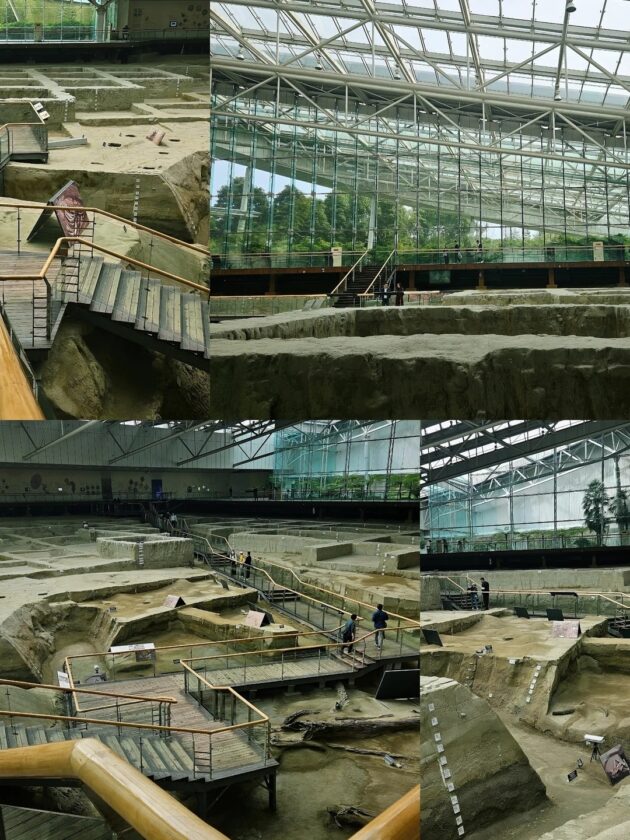
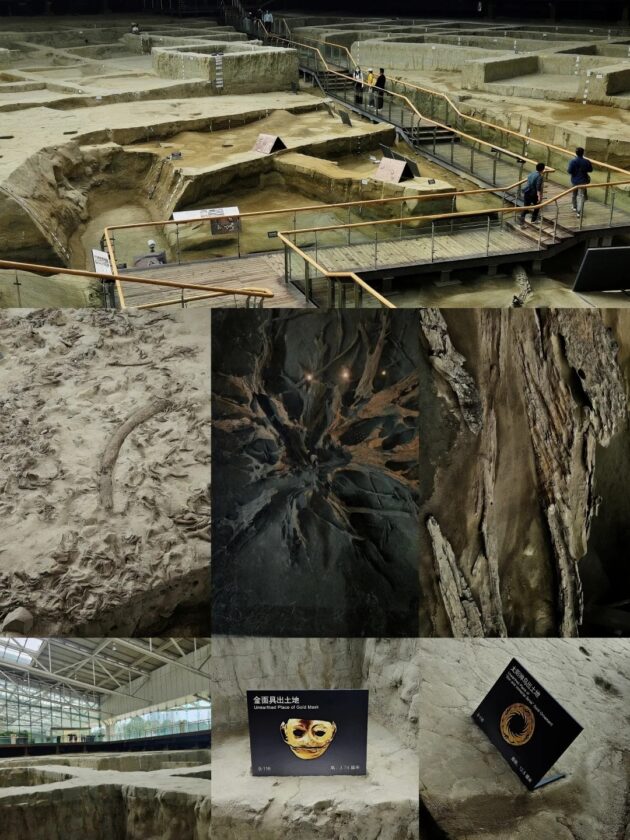
This is where the magic began. The hall is built directly over the original excavation pits, and as you walk along elevated metal walkways, you are literally standing above the 3,000-year-old ritual zone of the Shu Kingdom. Look down: you’ll see dozens of giant elephant tusks, boar tusks, deer antlers, and precious artifacts left in situ as they were found.
Touchscreens and signs explain the sacrificial layout. The sheer scale of ivory – over a ton of elephant tusks were unearthed here – is staggering. Soak in the atmosphere; this is not a re-creation but the real, raw archaeological site.
2. The Exhibition Hall (陈列馆) – Five Themed Galleries of Treasures
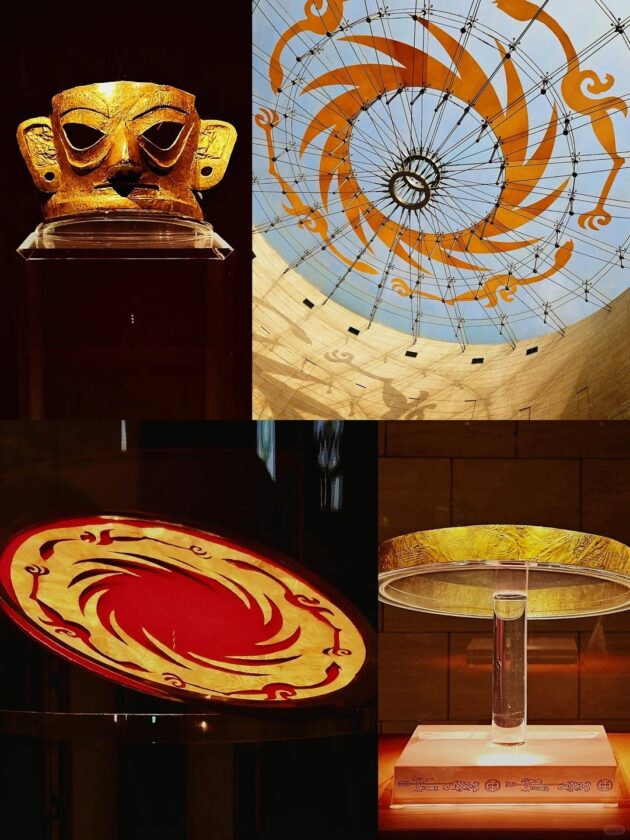
A striking sloping building with a sunbird-motif skylight, this hall houses the true masterpieces. Walk through its five galleries in numerical order:
Gallery 1: Ancient Homeland (远古家园): A moody, immersive space that recreates the marshy, forested Chengdu Plain of 3,000 years ago with sounds and life-sized dioramas, setting the ecological stage.
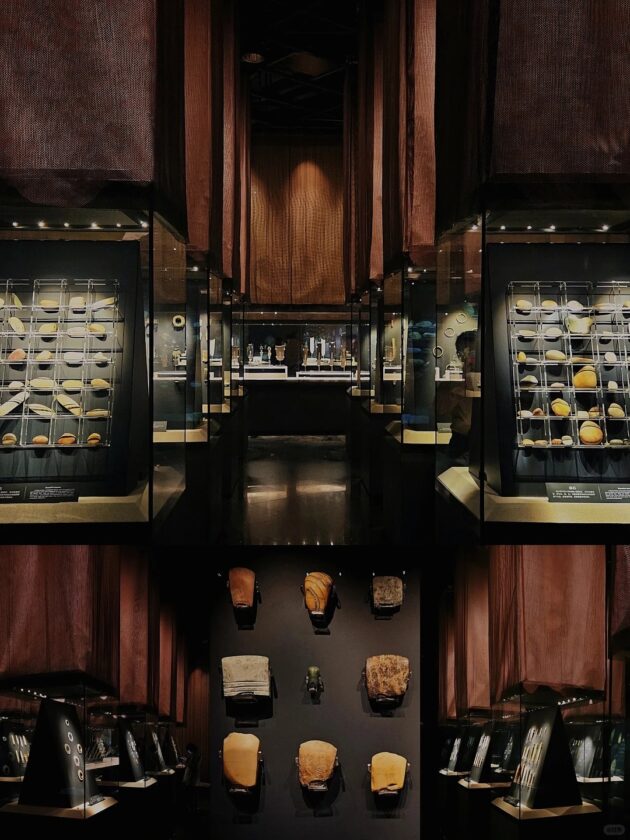
Gallery 2: Silhouette of the Royal Capital (王都剪影): Tools, pottery, jade, and architectural models that show daily life, urban planning, and craftsmanship in the Jinsha settlement.
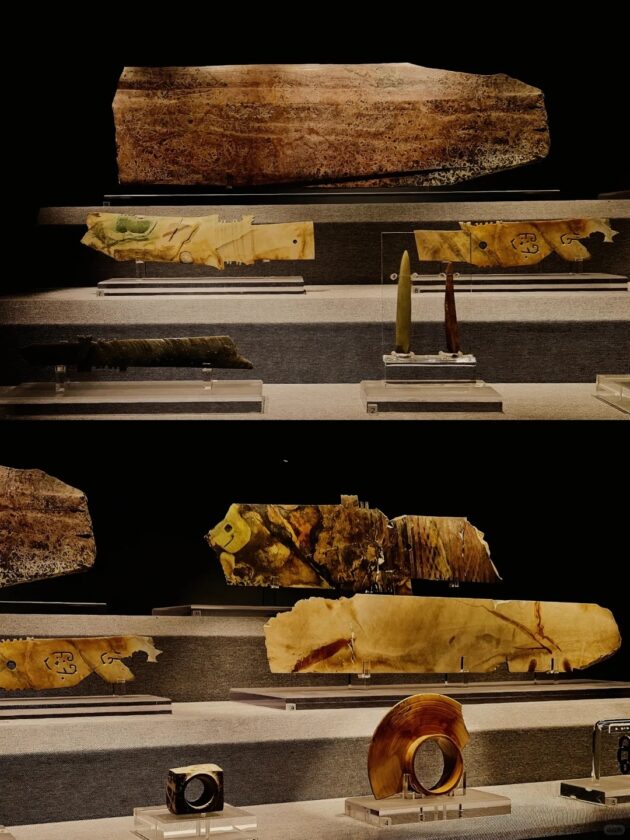
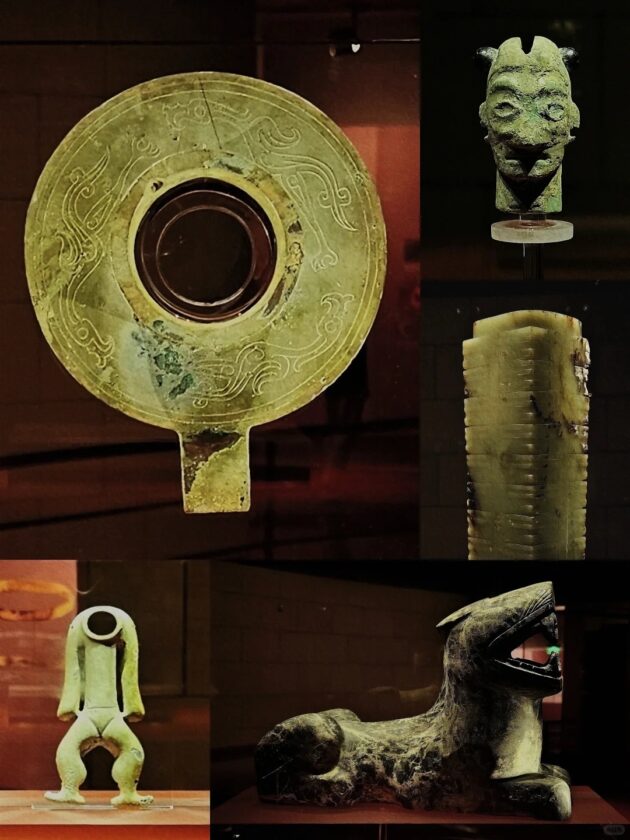
Gallery 3: Heaven and Earth Uninterrupted (天地不绝): A mysterious gallery filled with ritual objects – oracle bones, bronze sculptures, and jade weapons – that reveals the spiritual world of the Shu people. The lighting here is dramatic and haunting.
Gallery 4: Millennium Treasures (千载遗珍): The heart of the museum. This circular, temple-like room displays the five absolute treasures, one in the center and four in alcoves. The stars are:
Sun and Immortal Bird Gold Foil (太阳神鸟金饰): Just 0.02 cm thick and 20 grams in weight, this perfectly circular gold sheet shows four birds flying around a sun with twelve rays. It has become the official symbol of China’s cultural heritage. The craftsmanship is so exquisite it’s almost impossible to believe it’s three millennia old.
Gold Mask (黄金面具): A solemn, striking face hammered from a single sheet of gold, likely worn by a high priest or king during rituals. Its expression is both fierce and serene.
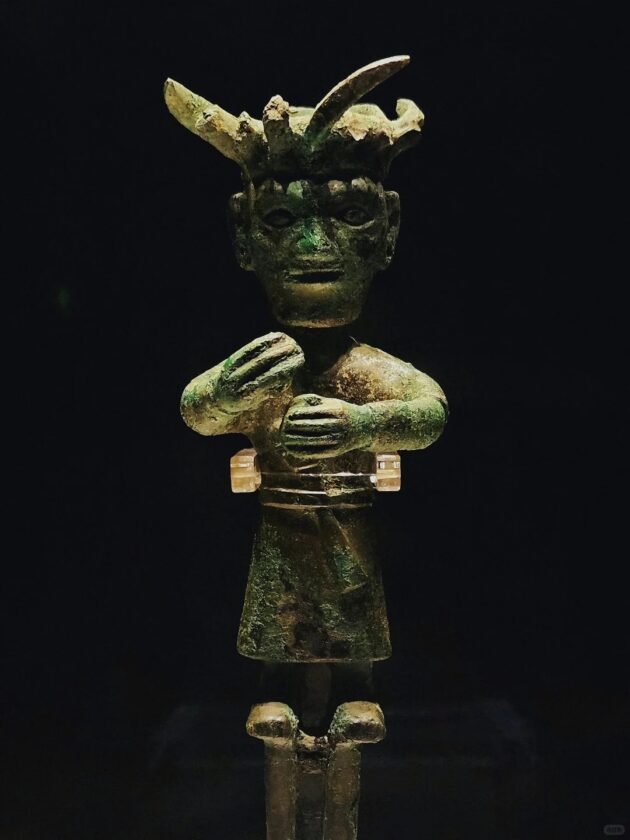
Bronze Standing Figure (青铜立人): Smaller and more stylized than its famous counterpart at Sanxingdui, this figure wears a distinctive hair knot and holds his hands in a ritual pose.
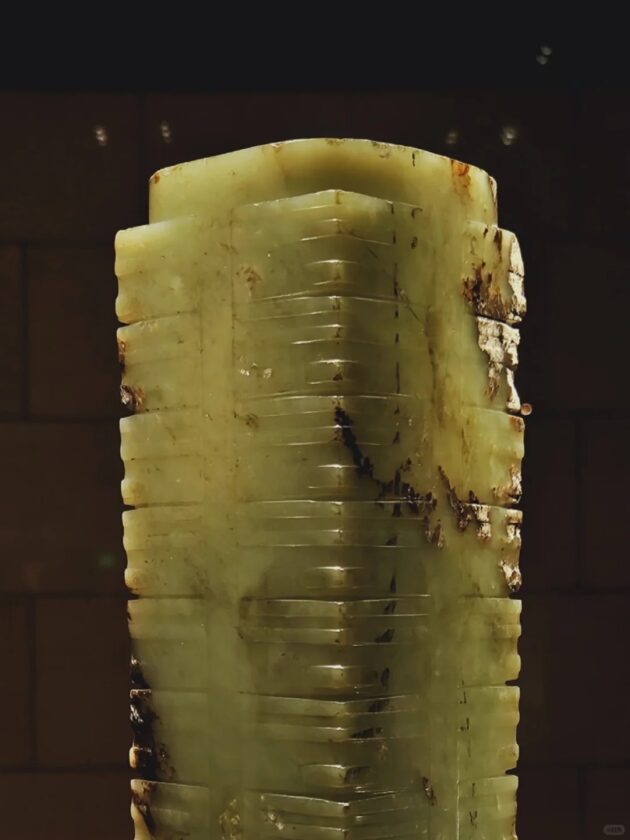
Jade Cong with Ten Sections (十节玉琮): A breathtaking, perfectly symmetrical jade tube carved with intricate faces, linking Jinsha with the Liangzhu culture thousands of miles to the east – evidence of vast ancient networks.
Gallery 5: Deciphering Jinsha (解读金沙): A thoughtful conclusion that traces the connections between Sanxingdui, Jinsha, and later Ba-Shu culture, suggesting Jinsha may have been the successor capital after Sanxingdui’s decline. Excellent maps and timelines.
3. Explore the Park and Its Hidden Corners
The museum sits within a serene 300,000-square-meter park dotted with ancient-looking trees. Don’t skip:
Ebony Forest (乌木林): Dozens of towering, blackened wood fossils (carbonized wood thousands of years old) jut out of the ground like a modern art installation. Incredible for photography.
Deer Park (鹿苑): Yes, there are deer! Sika deer roam a grassy enclosure, echoing the animals the Shu people once hunted and perhaps revered. You can watch them up close; it’s a delightful, unexpected break between galleries.
Jinsha Theatre & 4D Cinema: A 4D film (with English subtitles on request or via app) vividly reconstructs the story of ancient Jinsha. The main theatre occasionally stages the musical Jinsha, composed by the acclaimed Sanbao. Check the day’s schedule at the ticket office.
How to Get There
Metro: The easiest way. Take Line 7 (the loop line) to Jinsha Museum Station (金沙博物馆站), then use Exit C. You’ll emerge directly opposite the main gate, a two-minute walk.
Bus: Routes 5, 7, 83, 100, and others stop at “Jinsha Site East Gate” or “North Gate.”
Taxi/Ride-hailing: Show the driver “金沙遗址博物馆” (Jinsha Yizhi Bowuguan). From the city center (Chunxi Road area), it’s about 30–40 minutes and costs around 30–50 RMB.
Tickets & Opening Hours
Closed Mondays (except Chinese public holidays).
Admission: 70 RMB per adult. Half-price for students with valid ID, and free or discounted entry for seniors.
Booking: Tickets can be bought on-site or in advance via the official WeChat mini-program (“金沙遗址博物馆”). During peak holidays, advance booking is strongly recommended. Foreign visitors can use passports to purchase tickets at the counter or online.
Tips for a Great Visit
Get a guide or audio tour: Renting an English audio guide (around 20–40 RMB) or joining a guided tour (120 RMB for a small group, available at the desk) transforms the experience. Many artifacts are small and intricate; the stories behind them make the difference.
Download the app: The museum’s WeChat mini-program offers free audio guides in English – scan QR codes near exhibits.
Photography: Photography is allowed in most areas, but no flash is strictly enforced to protect the artifacts. The lighting in Gallery 4 is designed for atmosphere, not phone cameras; increase your exposure slightly.
Dress comfortably: You’ll be walking between two large halls and the gardens. Comfortable shoes are a must.
Services: There’s a café, a tea house, free drinking water dispensers, and clean restrooms. The museum shop (see below) is excellent.
Combine with other sites: Jinsha is located west of the city center. You can visit in the morning and then easily reach Du Fu’s Thatched Cottage (杜甫草堂) in the afternoon, which is only a short taxi or metro ride away.
Souvenirs – The Museum Shop
Jinsha’s cultural products are among the best in China. Look for:
Sunbird gold foil bookmarks and necklaces – elegant, iconic.
Bronze mask fridge magnets – quirky and distinctly Chengdu.
Jade replica ornaments and silk scarves printed with the sunbird pattern.
Puzzle cubes and excavation kits for children.
The shop near the main entrance has the widest selection. These make genuinely beautiful, non-kitschy gifts.
The Sanxingdui Connection
If you’ve been to (or plan to visit) Sanxingdui in Guanghan, Jinsha is the essential next chapter. Where Sanxingdui dazzles with monumental scale and wild imagination, Jinsha reveals a refined, mature continuation of that same civilization. Think of Sanxingdui as the thunderous first movement and Jinsha as the elegant, complex finale. Together, they rewrite the history of the Yangtze River civilization.
Final Thoughts
Jinsha Site Museum is a rare place where you can feel the weight of deep time and still enjoy every modern comfort. When you emerge from the dim galleries into the green park, blinking at the Chengdu sky, you’ll carry with you the image of four golden birds forever circling the sun – a symbol of a city that has been reinventing itself for three thousand years.