
Du Fu Thatched Cottage (杜甫草堂) Travel Guide (2026)
There is a quiet, green place in the heart of Chengdu where time is measured not in hours but in the rustle of bamboo leaves and the rhythm of ancient poetry. Du Fu Thatched Cottage is no ordinary museum – it is a sanctuary. Here, over 1,200 years ago, China’s greatest poet, Du Fu, found refuge from war, built a simple home beside a creek, and wrote more than 240 poems that are now immortal.
Today, the site is a sprawling classical garden, a temple of literature, and a deeply moving pilgrimage for anyone who loves words, beauty, or simply the feeling of being in a place that matters.
Best Time to Visit
The cottage is a year-round destination. Spring (March–May) brings magnolia blossoms and fresh green. Summer is lush with swaying bamboo, but can be hot and humid. Autumn (September–November) is perhaps the most exquisite: ancient ginkgo trees turn pure gold, the osmanthus flowers scent the air, and the whole garden feels like a poem.
Arrive right at opening time (8:00 am in summer, 8:30 am in winter) to experience the misty, tranquil atmosphere before the crowds. Allow 2 to 3 hours for a gentle, unhurried wander.
Top Things to See and Do
The site is a harmonious sequence of courtyards, halls, pavilions, and gardens, loosely following the layout of a traditional Sichuan residence. Follow this route to trace the poet’s spirit.
1. The Grand Entrance Sequence
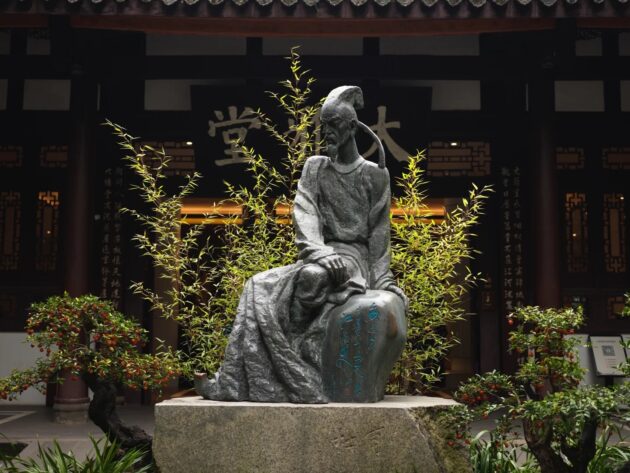
Pass through the screen wall and enter through the Main Gate (正门), then the Great Hall of Public Duty (大廨). Here stands a gaunt, bronze statue of Du Fu – not a triumphant dignitary, but a thin, thoughtful man seated in reflection, his face full of care for the world. Many visitors gently touch his hands for literary inspiration. The hall’s name is ironic and poignant: the poet who wrote so deeply of duty to the nation never held high office.
2. The Hall of Poetry History (诗史堂)
The spiritual centre of the cottage. Inside, a marble bust of Du Fu faces a large landscape mural, while along the walls are paintings depicting scenes from his life and lines from his most famous verses. The hall is called “Poetry History” because Du Fu’s work is so unflinching in its record of Tang-dynasty life, war, love, and sorrow that it reads as an intimate chronicle of an age.
3. The Thatched Gate and the Shrine (柴门 & 工部祠)
Walk deeper through Thatched Gate (Chai Men), whose simple wooden frame evokes the humble entrance to the poet’s original dwelling. Then arrive at the Shrine of the Ministry of Works (工部祠) – the solemn rear hall where Du Fu is enshrined alongside two other great poets: the lyrical Huang Tingjian and the patriotic Lu You. Incense and flower offerings are often placed here by admirers. The shrine is flanked by ancient osmanthus trees.
4. The Thatched Cottage (茅屋故居) – The Heart of the Place
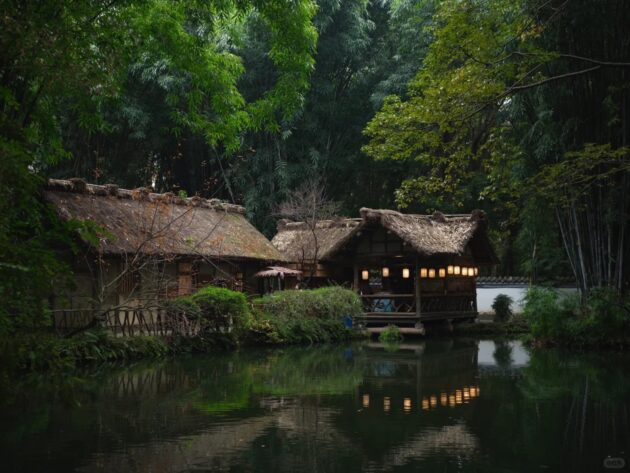
This is the iconic image of the whole site: a modest, reconstructed thatched-roof cottage set beside a winding stream. Inside, it is spartan: a simple desk, a wooden bed, a stove, and a worn door. Standing here, you feel the weight of the poem “My Cottage Unroofed by Autumn Winds” (茅屋为秋风所破歌), where Du Fu, shivering in the rain, dreamed not of his own comfort but of shelter for all the world’s poor. The bamboo groves and lotus pond surrounding the cottage are exquisitely photogenic; on a quiet morning, with mist rising off the water, it is pure poetry.
5. The Pavilion of “Shao Ling” Inkstone Tablet (少陵草堂碑亭)
A small, rounded pavilion covered in straw sits protectively over a giant stone tablet carved with the four characters “少陵草堂” (Shao Ling Thatched Cottage) in the bold calligraphy of an 18th-century Prince. It is the most-photographed symbol of the entire site and a serene spot to pause.
6. The Flower Path (花径)
A red-walled lane curved by ancient trees and bamboo. At its entrance hangs the couplet: “花径不曾缘客扫” (The flower path has never been swept for a guest), a line from Du Fu’s poem welcoming a visitor. Today, the red walls and lush greenery make it the most Instagrammed spot in the park. Go early to capture it without crowds.
7. The Tang-dynasty Relic Hall (唐代遗址陈列馆)
Beneath a pavilion within the grounds, glass floors reveal genuine Tang-dynasty archaeological remnants – well bases, pottery shards, and water channels – proving that the cottage area has indeed been a living settlement since the 8th century. It adds a layer of grounded reality to the poetic aura.
8. The Calligraphy Corridor of Du’s Poems (杜诗书法木刻廊)
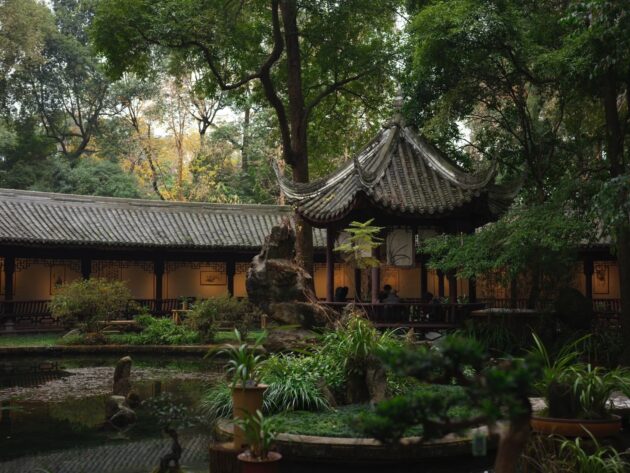
A long, shaded covered walkway lined with wooden plaques carved with exquisite calligraphy of Du Fu’s poems by masters through the ages. Walk slowly and recognise familiar lines – or simply admire the art of the brush.
9. The Bonsai Garden and Wanfo Pavilion (盆景园 & 万佛楼)
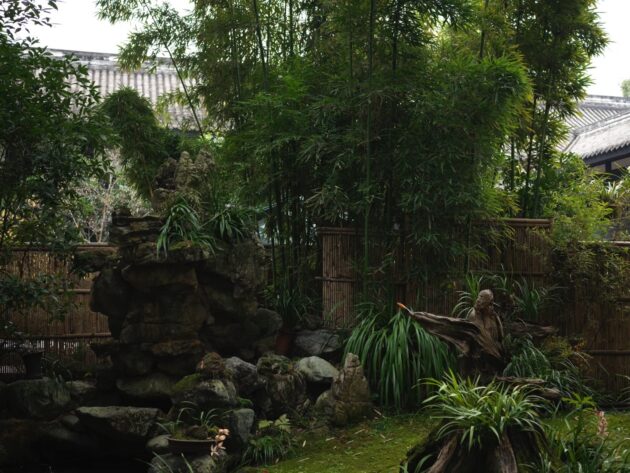
In the western part of the grounds, a bonsai garden holds miniature pines and rocks arranged in poetic forms. Climb the wooden Wanfo Pavilion (Ten Thousand Buddhas Pavilion) for a birds-eye view over the grey-tiled roofs of the cottage complex, merging into the modern city skyline beyond – a striking juxtaposition of ancient refuge and contemporary Chengdu.
10. Drink Tea in a Poet’s Garden
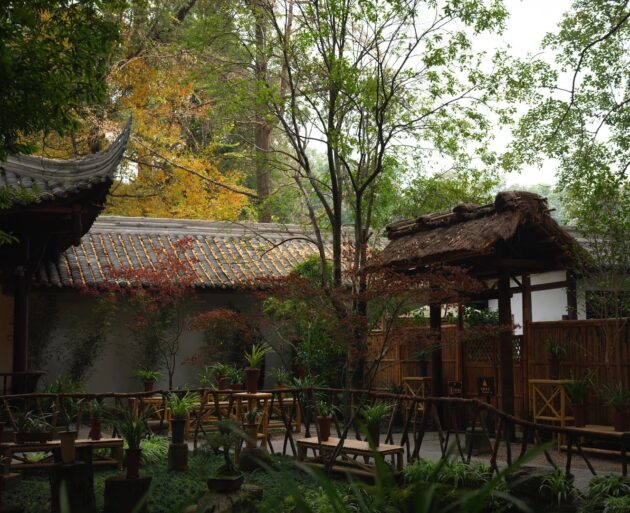
The cottage’s on-site tea house lets you sit among bamboo and lotus, sipping jasmine or bamboo-leaf-green tea, and reading a small volume of Du Fu’s poetry. There are few more Chengdu experiences than this.
How to Get There
Metro: Take Line 4 to Caotang North Road Station (草堂北路站), Exit B. Walk south along Caotang North Road for about 10 minutes; the main entrance is at the end. This is the best and simplest method.
Bus: Routes 19, 35, 47, 58, 82, 151, 165, 170, 1024, etc., stop near “Du Fu Thatched Cottage” or “Songxian Bridge” stations.
Taxi/Ride-hailing: Show the driver “杜甫草堂” or the address “青羊区青华路37号”. From Chunxi Road it takes about 25–30 minutes and costs 25–40 RMB.
Tickets & Opening Hours (Check Real-time Prices)
| Period | Hours | Last Entry |
|---|---|---|
| Summer (May–Oct) | 08:00 – 20:00 | 19:00 |
| Winter (Nov–Apr) | 08:30 – 18:30 | 17:30 |
Open year-round, including public holidays. No Monday closing (unlike many museums).
Admission: 50 RMB per adult. Half-price for students with valid ID. Seniors aged 60+ may enter free or with a discount (bring passport). Children under certain height free – check on-site.
Tickets: Can be bought at the gate or via the official WeChat mini-program (“杜甫草堂博物馆”). Foreign visitors can purchase with passport at the counter.
Tips for a Profound Visit
Read a poem before you go. Even just the first lines of “Spring View” (春望) or “My Cottage Unroofed by Autumn Winds” in translation will transform the experience. Look for translations by David Hinton, Burton Watson, or Stephen Owen.
Audio guide: Rent an English audio guide at the entrance (about 20–40 RMB with deposit). It provides rich context and recitations of the poems in Chinese, which are beautiful to hear even without knowing the language.
WeChat self-guide: Scan QR codes around the park for free English explanations on the museum’s official mini-program.
Dress for wandering: Cobbled paths, wooden bridges, and pebbled courtyards. Flat, comfortable shoes are essential.
Bring a notebook: There is something about this place that makes you want to write. The gift shop sells beautiful poetry cards and ink brushes.
Visit on a weekday for solitude, if possible. Rainy days, surprisingly, are the most atmospheric of all – the bamboo dripping with rain, mist among the pavilions, and the spirit of Du Fu’s storm-tossed evening all around you.
Combining Your Visit with Nearby Treasures
Du Fu’s Thatched Cottage sits in Chengdu’s most cultured district. Do not miss:
Sichuan Museum (四川博物院): A 10–15 minute walk away. The perfect complementary stop for its Zhang Daqian paintings, Han pottery, and ethnic galleries. Visit one in the morning and the other in the afternoon.
Huanhuaxi Park (浣花溪公园): The beautiful, free city park that stretches between the Cottage and the Sichuan Museum. It is filled with poetry-inscribed stones, a huge white egret statue, and a serene river. Locals come here to practice calligraphy with water on stone.
Shu Embroidery Museum: A tiny hidden treasure about 15 minutes’ walk where you can watch living masters stitching silk.
Souvenir Wisdom
The cottage shops sell elegant, literary keepsakes:
Small calligraphy scrolls of Du Fu’s poems (have the shop assistant explain the meaning).
Bookmarks printed with ink-brush couplets.
Replicas of the “Shao Ling Thatched Cottage” inkstone tablets.
Book sets of Tang poetry in Chinese-English editions when available.
Final Thoughts
Du Fu Thatched Cottage is not a place of grand spectacle. It is a place of feeling. You come because a poet lived here, suffered here, and created some of the most compassionate art the world has ever known. You leave with the faint scent of osmanthus, the echo of raindrops on a thatched roof, and perhaps a new awareness that the truest luxury is a moment of stillness in a bamboo grove, thinking of shelter for all.